DropDownMenu

01/02/2014

Teledata.cl and the recolonisation of rural Patagonia

Beka and Jose in Santiago put us in touch with some lovely people close to Ensenada. Sergio and his Swiss girlfriend Claudia have made a life for themselves in an amazing location on the shore of Lago Llanquihue opposite Volcan Osorno, running a little  telecommunications business bringing internet to rural communities, using some clever technology and line of sight antennae erected on hills, volcanoes and buildings all over the surrounding area. http://www.internetruralchile.com/


They transmit signals over incredible distances of up to 100km and then erect repeaters to spread the signals. They have 37 antennae and are helping communities stay alive in isolated places. Rural schools now have internet access despite being incredibly isolated and many professional people are now repopulating wild places and working over the fast internet that they now have access to, doing jobs like translating, or writing, or architecture.
A university friend of Sergio's called Diego who has moved South from Santiago explained to me how he uses software and Google Earth to work out the best locations to put towers, as their system relies on direct line of sight and even tree coverage can affect this. Diego's dream is that their network covers all of rural Patagonia even as far south as Villa O'Higgins! By chance the only place in southern Chile that can galvanise the steel towers that they make is 20 minutes down the road in Puerto Varas. We're sleeping in the small house where they paint the towers and it also serves as a place for the workers to have lunch.
They rent a small house directly from the local landowner who lives 100m away, and have built a rather stylish 'laboratory' on top of an old container, where Sergio tries out new ideas. There are aerials and towers lying around all over the place. It feels like a fun place to work, always new problems to solve and new ideas to be had. The new experiments involve using model helicopters and aeroplanes to possibly monitor wildlife, fires, volcanoes, salmon fisheries, farms and private houses and the 'lab' is stuffed with flight simulators, computers, control pads, VR glasses, home made kit for monitoring the aircraft and cases for moving them around. Sergio is waiting for better battery technology and is planning ahead.
They have also bought some land and are hoping to build a house on it in the next couple of years. The site is incredible, high in the hills surrounded by natural forest they have cleared space for gardens, outbuildings, vegetables, animals and a place for a house with views directly across to Volcan Osorno. We visited the land and trekked around the maze of paths and bamboo hillsides between their newly made road and the gorgeous clearing where they will build their simple house. This really is the land of opportunity!

Sunset on Volcan OsornoIMG_20140201_134038IMG_20140201_134132IMG_20140201_134144_MG_8903_MG_8906 _MG_8905_MG_8908_MG_8907IMG_20140201_134002IMG_20140201_133930IMG_20140201_134217 IMG_20140201_134205IMG_20140201_134247_MG_8923IMG_3451IMG_3454IMG_3453 IMG_3452_MG_8944_MG_8941_MG_8942_MG_8940_MG_8938
Sergio & Claudia's, a set on Flickr.

Volcanoes are cool

The splendid 2652m high Volcan Osorno with its perfect cone. All the craters are around the edges so the cone stays beautiful. What more needs saying?

First 1000km - 10 lessons from the road

1. Chile is very long and thin
2. It is impossible to travel with a baby and not lose stuff
3. Bed sheets in pensions are like the Bermuda Triangle
4. Do not attach things loosely to your bike on 'ripio' roads (dirt)
5. It is essential to have a good bra on bad ripio
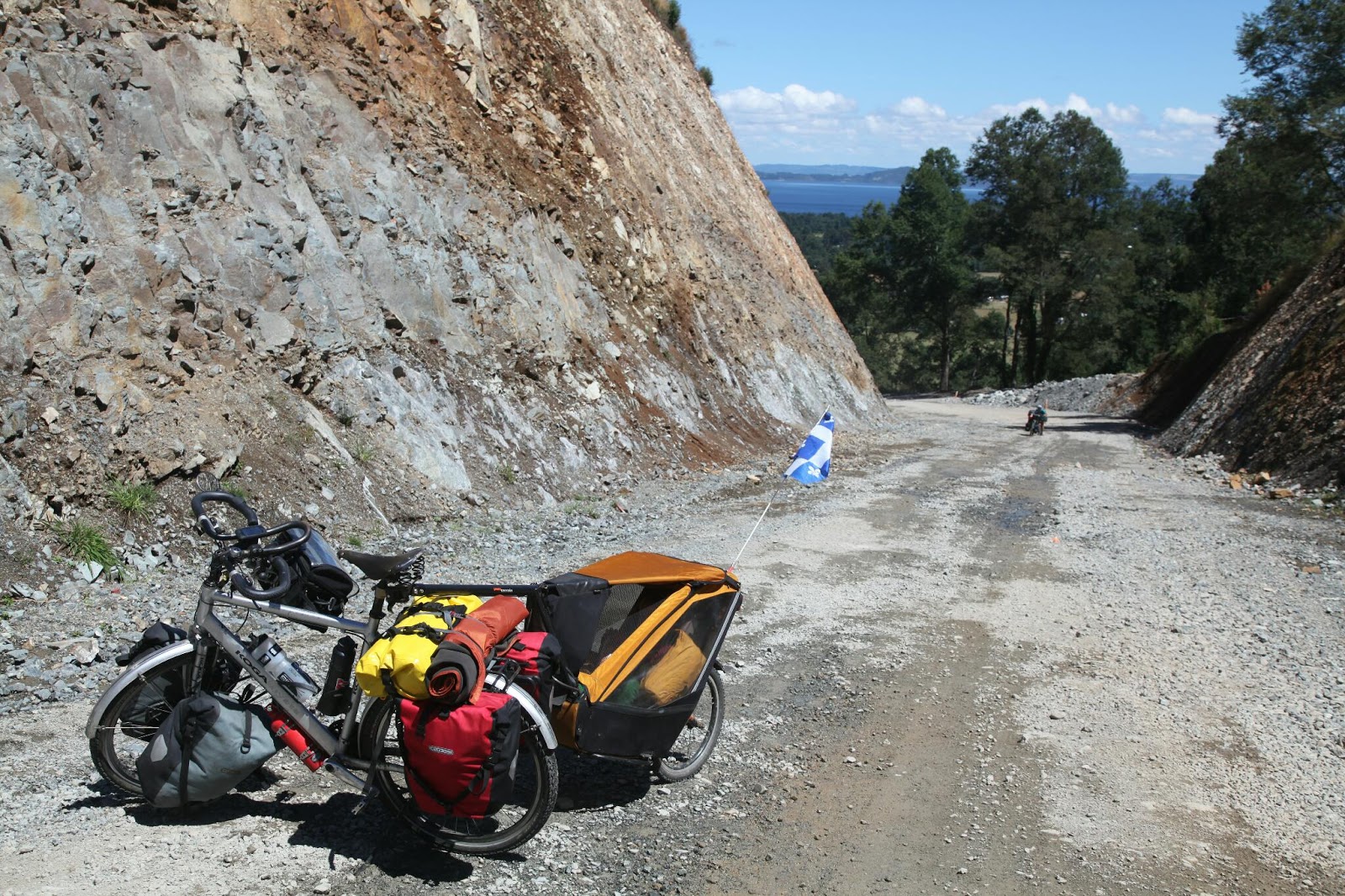
6. Road work ripio is close to hell
7. Traveling with a baby is easy, just slower
8. Slowing down is the new rock and roll
9. The first objects that Leo has grown really attached to are his shoes
10. There is a big difference between 'años' and 'anos'

30/01/2014

'Ripio' roads

We have been mainly travelling on goodish tar roads all the way south but recently we have been faced with some annoying choices. 200km on good tar or 50km on dirt roads is a fairly standard one. The tar roads nearly all seem to link up with the Pan American highway in a East/West direction so our journey is causing problems.
Quiet road ripio is absolutely fine, sometimes annoying, but then almost immediately is good again. What has made our journey worse is that the government are at long last upgrading the local roads in the Los Rios and Lakes District area so many of the roads have roadworks or are covered in shingle and waiting for tar. These roads are hell. Local traffic slows down for us poor cyclists and the dust clouds are negligible, delivery trucks just blast along creating clouds of dust that last for hundreds of metres and couldn't care less about us or the few pedestrians walking along. Most of the time these back roads are peaceful but unfortunately as soon as they are good they get bad again!

Lago Ranco

This lake was amazing, described poorly in the Lonely Planet of 2009 as a dusty frontier town with few shops and food options, we arrived after (and during) heavy rain and loved the place. There were supermarkets everywhere, cafés along the high street and a feeling of change and progress. In fact we spent 4 days circumnavigating its shoreline, staying in the many campsites on the way round and navigating the dirt roads (soon to be tar) that littered the eastern and southern edge. Our favourite place was the campsite at Saltos del Nilahue with its access to the large waterfall and the menagerie of animals for Leo's amusement. Cats, dogs, puppies, chickens and cockerels wandered the campsite, sheep, cows the adjacent fields, and these were joined by the wild birds and butterflies that fluttered through the trees above his head. Further round the lake, the town of Lago Ranco was ideallic although we have to remember never to camp on a Saturday night ever cagain, because the noise was terrible all night.

Lago Riñihue

On our way south from Lago Calafquen we saw a sign for a hotel on the shore of Lago Riñihue. We were intrigued because the road finished at the outflow of the lake and another road started on the other side and these two roads would cut 70km off our journey and allow us to miss out travelling along the Ruta Cinqo, the main highway south (part of the Pan-American highway). We wondered if there was a way across the river, maybe one for people but not cars. When we arrived we discovered that there was, but it was just a cable with a suspended pair of seats below it, and it was locked! Probably a good thing! The hotel was on the shore of the lake and had amazing grounds, owned by a family of French descent, and while it was a little expensive for us, proved to be a brilliant place for Leo to play. He just roamed the grounds like a wild child, played in the lake, climbed rocks and tree roots while we chilled.

23/01/2014

'Botas de Goma'

With it raining a lot we realised that it is hard to keep Leo dry and entertained. He needs excitement and activities, something that involves inevitably getting wet. So we bought some boots.

We weren't sure that a child could have more fun. Leo walked around the town of Futrono in every gutter on almost every road, as the rain poured down. People came out of shops to watch him stamping his feet with a massive smile on his face as we protected him from cars. 3 hours later he finally slowed down, fell over twice, started crying and then ate a whole gigantic avocado, 30 grapes and a large piece of bread in one focused meal.

These boots are now his favourite things.

21/01/2014

Los Rios & Lakes


Los Rios & Lakes, a set on Flickr.
South of Temuco, and stretching for the next few 100km is a region of Chile known as the gateway to the Lakes district. This is where many Santiago based Chileans have their summer holidays thanks to the cold ocean currents and winds that keep the coastal beaches relatively quiet. The whole area is full of snow-capped volcanoes and gorgeous warm lakes although each of the many lakes has its own character, our first, Lago Calafquen being known for its back volcanic sandy beaches, Lago Ranco for its islands and boat trips and Lago Riñihue for its peaceful fishing and birdwatching. Most of the roads are asphalt, a few 'ripio' or dirt, the landscape is fantastic.